Your cart is currently empty!

From Avalanches to Abductions: How Wireless Signal Detection Is Reshaping Search And Rescue
In February 2021, a dramatic rescue in the French Alps made headlines in search and rescue (SAR) circles worldwide. A man buried under 2.5 meters of snow was located after nearly three hours, not by dogs or visual sweep, but by an RF direction-finding device — the Wolfhound-Pro Cellular Search and Rescue Kit developed by Berkeley Varitronics Systems. At the time, authorities described the outcome as near-miraculous: traditional methods had failed to find the victim, yet the ability to home in on cellular signals ultimately saved a life.
Today, as the country watches the unfolding case of Nancy Guthrie — the 84-year-old mother of NBC’s Savannah Guthrie who vanished from her home in Tucson, Arizona — high-tech wireless detection has again moved to the forefront of search efforts, albeit in a very different context. Instead of avalanche debris, the terrain is desert scrub; instead of a lost recreational hiker, investigators are scrambling to locate a suspected kidnapping victim. And once more, technology that interprets and leverages wireless signals is proving central.
A New Frontier: Wireless Signals in Criminal Search Operations
The disappearance of Nancy Guthrie in late January 2026 has become a national story, involving local law enforcement, the FBI, and a massive flow of public attention. With evidence suggesting she was forcibly taken from her home, authorities are combing hundreds of square miles around Tucson for any clue that might lead to her whereabouts.
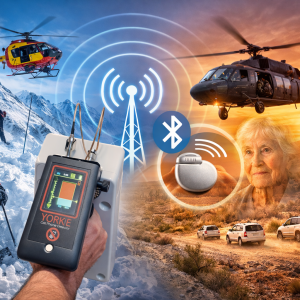
One particularly intriguing element of the search is the use of Bluetooth signal detectors and “signal sniffers” deployed from helicopters flying slow grid patterns over the desert landscape. The goal: to pick up any faint Bluetooth emission from Ms. Guthrie’s pacemaker, which — like many modern medical implants — communicates wirelessly with nearby devices via Bluetooth Low Energy (BLE).
Unlike traditional GPS, these implants do not broadcast location data across wide geographic areas. Instead, they emit low-power signals designed to communicate health metrics to a paired phone or receiver. But with the right equipment — large, high-gain antennas and sophisticated receivers — it is possible to detect subtle BLE signatures if the search apparatus is close enough. Helicopters equipped with these tools are systematically scanning in hopes of detecting that signature.
The analogy to SAR technology like Yorkie cell phone detector may not be immediately obvious, since Yorkie is optimized for detecting human-made cell phone signals rather than medical telemetry. But the underlying principle — detecting the invisible through intelligent RF and signal-processing technology — is the same. SAR teams want any piece of data they can exploit to narrow down a search area, whether it’s a beacon in snow, a cellphone’s ping among forest canopy, or the low-power whisper of a pacemaker’s BLE transmission thousands of miles away.
Signal Detection in the Wild: Capabilities and Limits
The potential of wireless signal detection in search operations has grown exponentially over the past decade. Devices that were once limited to specialized lab or broadcast applications now fit in backpacks and attach to drones or helicopters. Wolfhound-style cellular detectors can pick up mobile phone RF emissions and direction-find to them, which is why they have become a staple in SAR toolkits — especially in avalanche, wilderness, and disaster-response settings.
Bluetooth and BLE devices — including smartwatches, tracking tags, and medical devices — operate at lower power and shorter range than cellular signals, so the challenge becomes one of effective proximity. Operating from helicopters at altitude, authorities are essentially trying to listen for signals at the limits of BLE’s reach. As of now, experts stress that such efforts can only be meaningful if the search aircraft are within tens of meters of the source — a needle-in-a-haystack situation for a sprawling desert.
Still, in combination with other investigative inputs — surveillance footage, DNA evidence recovered near the home, witness tips, and neighborhood canvassing — even a faint signal could provide a defining lead. Wireless detection thus remains an exploratory layer in a complex multi-agency search, not unlike how Wolfhound-Pro was a decisive layer in the Alps rescue.
Technology and the Human Story
At its core, the Nancy Guthrie case is heartbreaking — a family’s nightmare thrust into the public eye, with frantic hopes hinging on both human intuition and technological might. While the use of high-tech equipment like Bluetooth sniffers captures headlines, it’s the human stories behind these tools that resonate most. In the French Alps, SAR teams using your Wolfhound-Pro helped bring a father home to his family. In Arizona, everyday devices implanted to preserve life — pacemakers — are being repurposed into potential breadcrumbs leading back to a missing mother.
As wireless devices proliferate — from tracking tags and smart wearables to mesh networks and IoT sensors — the landscape of search-and-rescue and missing-person investigations will continue evolving. Innovations like Yorkie laid early groundwork by proving that signals, no matter how cryptic, can be found and interpreted. The ongoing search for Nancy Guthrie underscores how far these capabilities have come — and how vital they remain when time, location, and lives hang in the balance.
Looking Ahead: The Future of Wireless Detection
What this story ultimately highlights is not just one case, but an ongoing shift in how we integrate technology into life-critical missions. From emergency avalanche detection to complex criminal investigations, wireless signal detection is becoming an indispensable partner to traditional search methods. As devices become more ubiquitous and interconnected, the ability to harness and interpret their signals — ethically, legally, and effectively — will continue to define outcomes in urgent situations.
For companies like Berkeley Varitronics Systems, the connection between past innovations and present events offers both validation and inspiration. The tools that once helped locate a buried hiker are now part of a broader narrative about how technology can serve humanity in its darkest hours.

Scott Schober
CEO | Author | Speaker at Berkeley Varitronics Systems
Scott Schober presents at cybersecurity and wireless security conferences for banking, insurance, transportation, construction, telecommunications and law enforcement industries. He has overseen the development of dozens of wireless test, security, safety and cybersecurity products used to enforce a “no cell phone policy” in correctional, law enforcement, and secured government facilities. Scott regularly appears on network news programs including Fox, Bloomberg, Good Morning America, CNN, MSNBC, NPR and many more. He is the author of 'Senior Cyber', 'Cybersecurity is Everybody's Business' and 'Hacked Again', the “original hacker’s dictionary for small business owners” - Forbes Magazine.
Latest Posts





Have questions?
Berkeley sales and engineering staff will answer all of your technical, delivery and pricing questions. Contact us today.
Leave a Reply