Your cart is currently empty!

Wireless Threats: Inside & Outside The Box
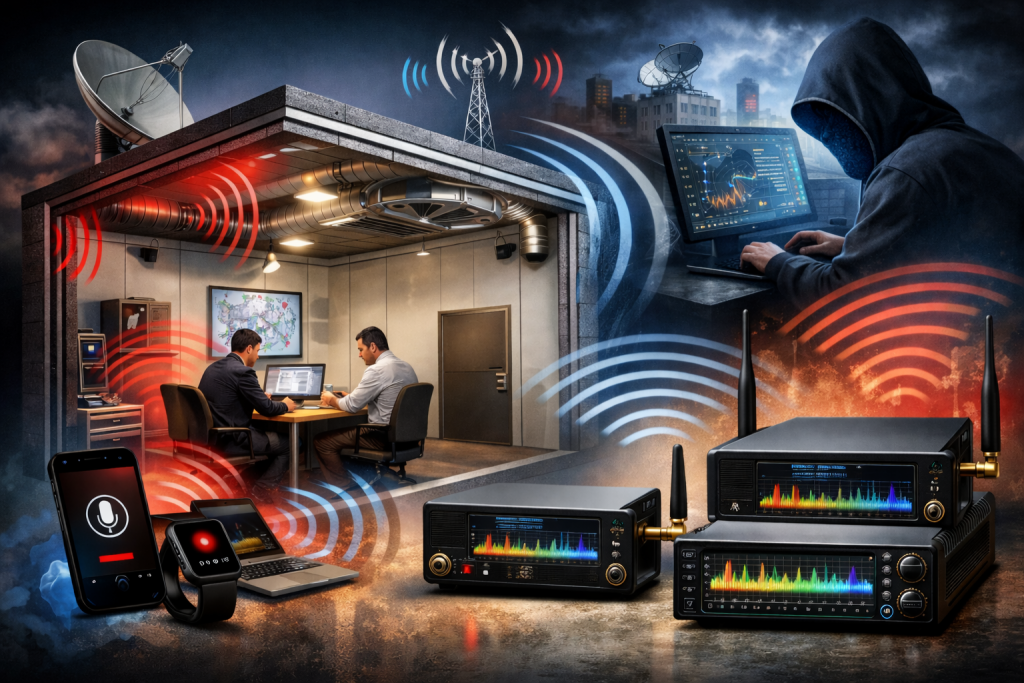
Sensitive Compartmented Information Facilities (SCIFs) represent some of the most secure environments in government, defense, and intelligence operations. These facilities are specifically designed to store, process, and discuss classified information whose compromise could result in significant national security consequences. Because of this mission, SCIFs rely on layered security controls that address not only physical access, but also acoustic, electromagnetic, and radio frequency (RF) threats that are often invisible to the naked eye.
Wireless Devices: A Persistent and Growing Threat
One of the most significant and persistent risks to SCIF security is wireless communication. Modern wireless technologies are pervasive, low-power, and highly capable. Cell phones, smart watches, tablets, laptops, and other personal electronic devices (PEDs) are prohibited inside accredited SCIFs because they continuously emit RF energy, even when they appear to be idle.
Cellular registration traffic, Bluetooth advertisements, Wi-Fi probing, and background system telemetry can all occur without user interaction. In addition, these devices contain microphones, cameras, and sensors that can be remotely activated if compromised, turning an otherwise harmless object into a covert surveillance or data exfiltration tool.
How Classified Information Can Leak Wirelessly
The danger is amplified by the fact that classified information within a SCIF is often discussed verbally and displayed visually. A single unauthorized wireless device, or an unintended RF leakage path, can allow sensitive information to escape the facility or enable adversaries to monitor activity from outside the secure perimeter. For this reason, SCIF security policies treat wireless emissions as a critical threat vector rather than a convenience tradeoff.
Why RF Leakage Is Hard to Detect
RF energy does not stop at walls or doors. Signals can leak through seams in shielding, cable penetrations, ventilation paths, power lines, or improperly bonded structural elements. Even well-designed shielding systems can develop weaknesses if installation details are overlooked.
These vulnerabilities are particularly dangerous because they are rarely obvious and may only become apparent under specific frequency or power conditions. Without deliberate testing, RF leakage can remain undetected until after a facility is occupied and operational.
The Construction Phase: The Best Time to Find Problems
The construction phase of a new SCIF is therefore the most important opportunity to identify and mitigate RF vulnerabilities. During construction or major renovation, shielding materials are accessible, penetrations can be redesigned or sealed, grounding and bonding can be corrected, and remediation can be performed at a fraction of the cost and disruption required after accreditation.
RF testing at this stage helps security teams understand what signals may unintentionally enter or exit the space, whether shielding performs as designed across relevant threat bands, and whether resonant or coupling paths exist that could be exploited.
What Is an RF Stimulus Source?
A key tool used in this process is the RF stimulus source. A stimulus source is a controlled transmitter that intentionally generates RF signals across specific frequency ranges and power levels so that shielding effectiveness and leakage paths can be evaluated.
Unlike single-frequency generators, modern wideband stimulus sources allow testing across the same diverse spectrum used by real-world wireless threats. This enables more realistic validation of SCIF defenses against contemporary espionage techniques.
The Lizard Dual-Band 1-Watt Stimulus Source
One commonly used platform is the Lizard dual-band 1-watt stimulus source. This system provides two transmit paths, with the first covering 100 to 620 MHz and the second covering 540 to 6000 MHz, both with fine 2.5 kHz tuning resolution.
The wide frequency coverage allows testing of traditional VHF and UHF threats as well as modern microwave-band technologies such as Wi-Fi, Bluetooth, and ISM-band devices. The 1-watt output level is well suited for controlled testing during construction, enabling precise leakage mapping and validation of shielding continuity without introducing unnecessary risk or interference.
The Dragon Dual-Band 5-Watt Stimulus Source
For more demanding environments, the Dragon dual-band 5-watt stimulus source is often employed. This platform also uses a two-transmitter architecture, with one transmitter covering 100 to 620 MHz and the second covering 620 to 2700 MHz, again with 2.5 kHz tuning steps.
The higher output power allows security teams to stress the shielding system more aggressively, exposing marginal seams, penetrations, or coupling paths that may not appear under lower-power conditions. This makes the Dragon particularly valuable for final pre-accreditation testing, large or complex SCIFs, and scenarios where signals must be driven through multiple barriers or across greater distances.
Why Wideband Testing Reflects Real-World Threats
Wideband stimulus sources like the Lizard and Dragon are effective because they reflect the reality of modern wireless threats. Adversaries no longer rely on a narrow set of frequencies; instead, they exploit a broad spectrum ranging from sub-GHz bands through cellular and into microwave frequencies.
Fine frequency resolution allows testers to identify narrowband devices, frequency-hopping signals, and subtle leakage paths that could otherwise be missed. The ability to transmit multiple test signals further enhances realism and confidence in the results.
Conclusion: Building RF Security In From the Start
Ultimately, SCIF security depends on more than policies and physical barriers. It requires deliberate, technically rigorous RF validation to ensure that classified information cannot be compromised through unintended wireless paths.
Conducting comprehensive RF testing during construction is one of the most effective ways to reduce long-term risk and avoid costly remediation later. Wideband stimulus sources such as the Lizard dual-band 1-watt and Dragon dual-band 5-watt platforms play a critical role in this effort, enabling security teams to identify vulnerabilities, verify shielding performance, and protect the sensitive information entrusted to SCIF environments.

Scott Schober
CEO | Author | Speaker at Berkeley Varitronics Systems
Scott Schober presents at cybersecurity and wireless security conferences for banking, insurance, transportation, construction, telecommunications and law enforcement industries. He has overseen the development of dozens of wireless test, security, safety and cybersecurity products used to enforce a “no cell phone policy” in correctional, law enforcement, and secured government facilities. Scott regularly appears on network news programs including Fox, Bloomberg, Good Morning America, CNN, MSNBC, NPR and many more. He is the author of 'Senior Cyber', 'Cybersecurity is Everybody's Business' and 'Hacked Again', the “original hacker’s dictionary for small business owners” - Forbes Magazine.
Latest Posts





Have questions?
Berkeley sales and engineering staff will answer all of your technical, delivery and pricing questions. Contact us today.
Leave a Reply